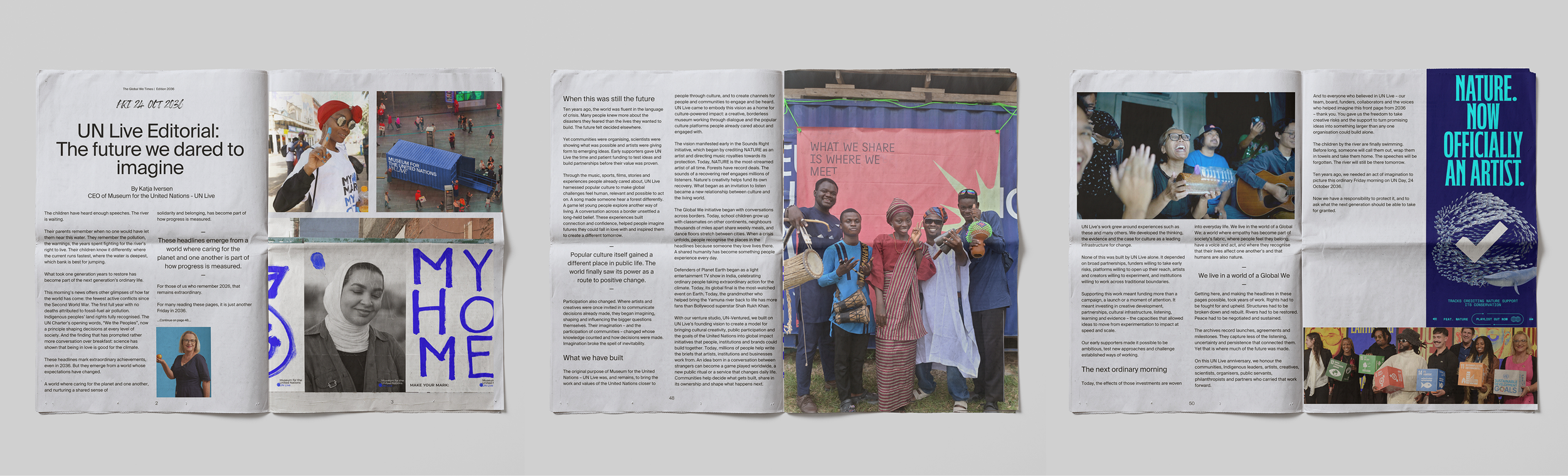
The Global We Times
Special Edition · UN Day · 24 October 2036
By Katja Iversen, CEO of Museum for the United Nations – UN Live
The children have heard enough speeches. The river is waiting.
Their parents remember when no one would have let them near this water. They remember the pollution, the warnings, the years spent fighting for the river’s right to live. Their children know it differently: where the current runs fastest, where the water is deepest, which bank is best for jumping.
What took one generation years to restore has become part of the next generation’s ordinary life.
This morning’s news offers other glimpses of how far the world has come: the fewest active conflicts since the Second World War. The first full year with no deaths attributed to fossil-fuel air pollution. Indigenous peoples’ land rights fully recognised. The UN Charter’s opening words, “We the Peoples”, now a principle shaping decisions at every level of society. And the finding that has prompted rather more conversation over breakfast: science has shown that being in love is good for the climate.
These headlines mark extraordinary achievements, even in 2036. But they emerge from a world whose expectations have changed. A world where caring for the planet and one another, and nurturing a shared sense of solidarity and belonging, has become part of how progress is measured.
For those of us who remember 2026, that remains extraordinary.
For many reading these pages, it is just another Friday in 2036.
When this was still the future
Ten years ago, the world was fluent in the language of crisis. Many people knew more about the disasters they feared than the lives they wanted to build. The future felt decided elsewhere.
Yet communities were organising, scientists were showing what was possible and artists were giving form to emerging ideas. Early supporters gave UN Live the time and patient funding to test ideas and build partnerships before their value was proven.
Through the music, sports, films, stories and experiences people already cared about, UN Live harnessed popular culture to make global challenges feel human, relevant and possible to act on. A song made someone hear a forest differently. A game let young people explore another way of living. A conversation across a border unsettled a long-held belief. These experiences built connection and confidence, helped people imagine futures they could fall in love with and inspired them to create a different tomorrow.
Popular culture itself gained a different place in public life. The world finally saw its power as a route to positive change.
Participation also changed. Where artists and creatives were once invited in to communicate decisions already made, they began imagining, shaping and influencing the bigger questions themselves. Their imagination – and the participation of communities – changed whose knowledge counted and how decisions were made.
Imagination broke the spell of inevitability.
What we have built
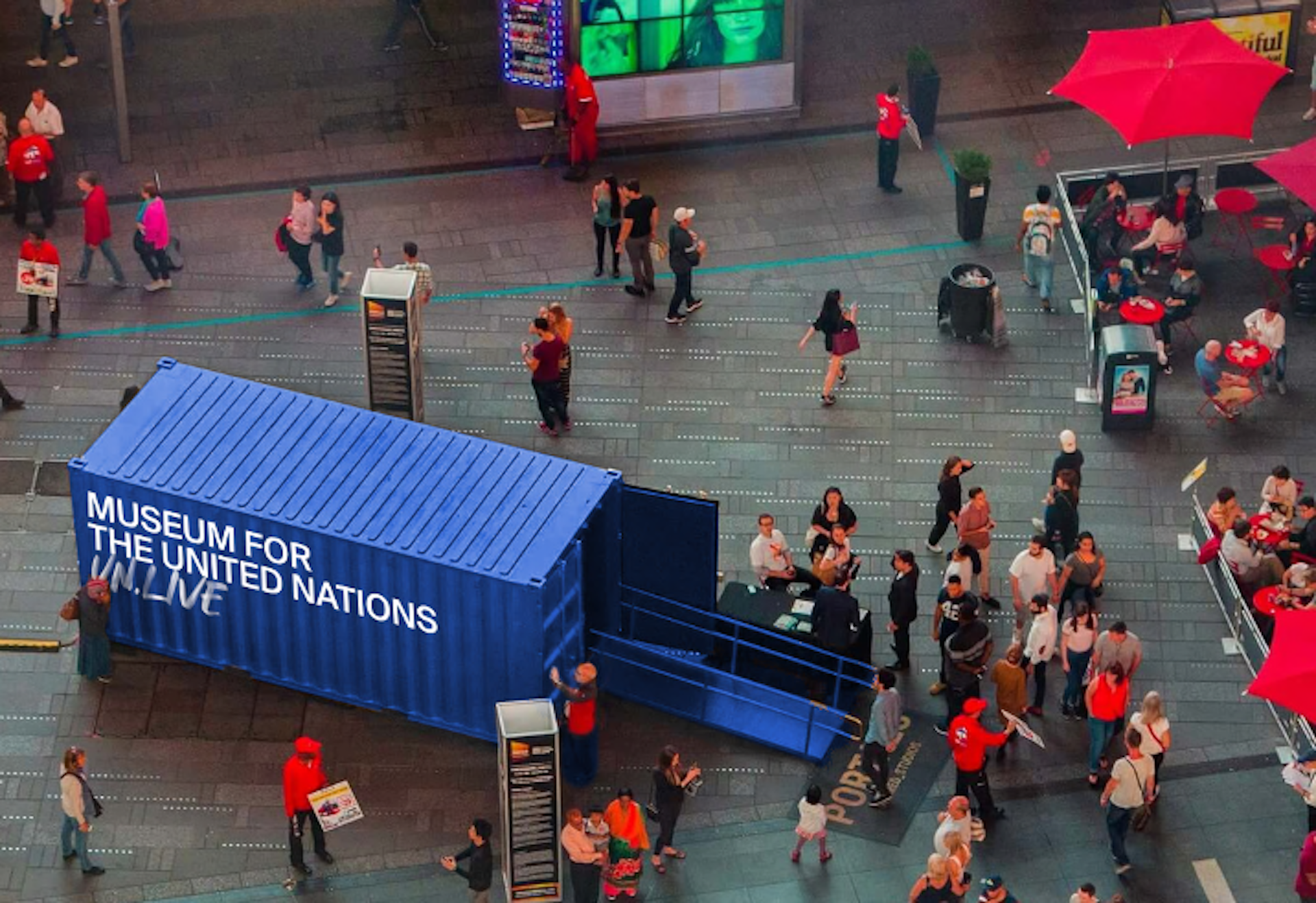
The original purpose of Museum for the United Nations – UN Live was, and remains, to bring the work and values of the United Nations closer to people through culture, and to create channels for people and communities to engage and be heard. UN Live came to embody this vision as a home for culture-powered impact: a creative, borderless museum working through dialogue and the popular culture platforms people already cared about and engaged with.
The vision manifested early in the Sounds Right initiative, which began by crediting NATURE as an artist and directing music royalties towards its protection. Today, NATURE is the most-streamed artist of all time. Forests have record deals. The sounds of a recovering reef engages millions of listeners. Nature’s creativity helps fund its own recovery. What began as an invitation to listen became a new relationship between culture and the living world.
The Global We initiative began with conversations across borders. Today, school children grow up with classmates on other continents, neighbours thousands of miles apart share weekly meals, and dance floors stretch between cities. When a crisis unfolds, people recognise the places in the headlines because someone they love lives there. A shared humanity has become something people experience every day.
Defenders of Planet Earth began as a light entertainment TV show in India, celebrating ordinary people taking extraordinary action for the climate. Today, its global final is the most-watched event on Earth. Today, the grandmother who helped bring the Yamuna river back to life has more fans than Bollywood superstar Shah Rukh Khan.
With our venture studio, UN-Ventured, we built on UN Live’s founding vision to create a model for bringing cultural creativity, public participation and the goals of the United Nations into global impact initiatives that people, institutions and brands could build together. Today, millions of people help write the briefs that artists, institutions and businesses work from. An idea born in a conversation between strangers can become a game played worldwide, a new public ritual or a service that changes daily life. Communities help decide what gets built, share in its ownership and shape what happens next.
UN Live’s work grew around experiences such as these and many others. We developed the thinking, the evidence and the case for culture as a leading infrastructure for change.
None of this was built by UN Live alone. It depended on broad partnerships, funders willing to take early risks, platforms willing to open up their reach, artists and creators willing to experiment, and institutions willing to work across traditional boundaries.
Supporting this work meant funding more than a campaign, a launch or a moment of attention. It meant investing in creative development, partnerships, cultural infrastructure, listening, learning and evidence – the capacities that allowed ideas to move from experimentation to impact at speed and scale.
Our early supporters made it possible to be ambitious, test new approaches and challenge established ways of working.
The next ordinary morning
Today, the effects of those investments are woven into everyday life. We live in the world of a Global We: a world where empathy has become part of society’s fabric, where people feel they belong, have a voice and act, and where they recognise that their lives affect one another’s and that humans are also nature.
Getting here, and making the headlines in these pages possible, took years of work. Rights had to be fought for and upheld. Structures had to be broken down and rebuilt. Rivers had to be restored. Peace had to be negotiated and sustained.
The archives record launches, agreements and milestones. They capture less of the listening, uncertainty and persistence that connected them. Yet that is where much of the future was made.
On this UN Live anniversary, we honour the communities, Indigenous leaders, artists, creatives, scientists, organisers, public servants, philanthropists and partners who carried that work forward.
And to everyone who believed in UN Live – our team, board, funders, collaborators and the voices who helped imagine this front page from 2036 – thank you. You gave us the freedom to take creative risks and the support to turn promising ideas into something larger than any one organisation could build alone.
The children by the river are finally swimming. Before long, someone will call them out, wrap them in towels and take them home. The speeches will be forgotten. The river will still be there tomorrow.
Ten years ago, we needed an act of imagination to picture this ordinary Friday morning on UN Day, 24 October 2036.
Now we have a responsibility to protect it, and to ask what the next generation should be able to take for granted.